


Wreckfest - Demolition Racing
HandyGames
I went into Wreckfest - Demolition Racing expecting a familiar mobile racer, but its appeal became clear almost immediately: this is less about completing a perfectly clean lap and more about surviving contact, choosing when to attack, and turning a messy race into a win. HandyGames brings a full-contact racing game to Android, aimed at players who enjoy crashes, damaged cars, and the satisfaction of making progress even when a race goes badly.
The game sits in the racing category, but it does not feel like a simple time-trial experience. Traditional mobile racers often reward smooth cornering, careful braking, and avoiding every rival. Here, bumping another car can be part of the plan. That changes how I read the track. I am not only looking for the fastest line; I am also watching for openings, judging whether a collision will help me, and deciding when a risky move is worth the damage it may cause.
That difference is important for a first-time player. If you want a calm driving game where every race is about precision and clean competition, this may feel rougher than expected. If you like the unpredictable moments that happen when several cars fight for the same space, the central idea is much easier to appreciate. This is a racing game built around controlled chaos, not spotless driving.
Getting comfortable before chasing the first win
What the first launch tells you
Wreckfest is a paid game, listed at $10.99, with optional in-app purchases ranging from $0.99 to $10.99 per item. That makes it worth approaching with a different expectation from a free racer filled with short sessions and constant prompts. I see it as a more substantial purchase: something to spend time learning rather than something to open for a few seconds and immediately abandon.
The game is rated Teen, which fits the aggressive racing style and the emphasis on crashes. It was released on November 15, 2022, and the current version is 1.0.111. Android users need at least Android 9. Before installing, I would check that the device meets that requirement and has enough comfortable storage and battery headroom for a 3D racing game. I would also avoid judging the experience during the first few minutes if the controls feel unfamiliar; the driving model asks for a little adjustment.
Related News






The store shows an average rating of 3.8 from around 6,500 ratings, with roughly 450 written reviews and over 100,000 installs. Those figures suggest a real audience, but also a mixed enough reception that I would not describe the game as an automatic fit for every phone or every racing fan. Device performance, control preference, and tolerance for collisions will strongly affect whether it feels enjoyable.
My approach to the first setup
On the first run, I recommend resisting the urge to treat the opening race as a test of maximum speed. Use it to learn how the car responds when you release the accelerator, how much room you need before a corner, and how quickly a small impact changes your position. The most useful early habit is to look farther ahead than the car directly in front of you. In a crowded pack, the next collision often begins two or three cars away.
Touch controls can make this especially important. Small corrections are usually safer than dramatic swipes or repeated steering changes. I try to keep my inputs calm on a straight section, then make one deliberate steering adjustment for the corner. If I panic and keep correcting after the car has already started turning, I create the kind of wobble that lets rivals pass or sends me into the barrier.
Gallery
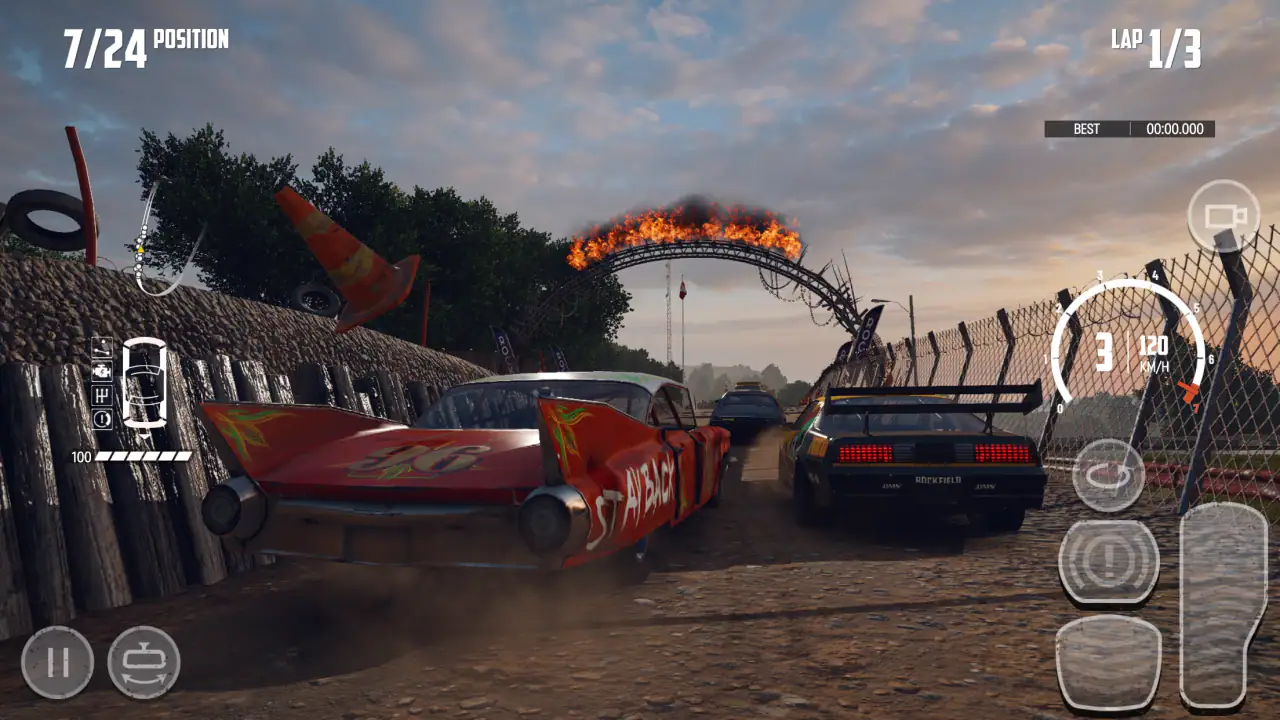
Players who normally use a controller in racing games should give the default mobile controls a fair trial, but they should also notice whether their hands are covering the action. A control layout that feels fine on a large screen may be less comfortable on a smaller phone. My practical advice is to play the opening events while seated, with the phone held securely, rather than assuming the game will be equally manageable during a rushed commute.
The first meaningful success is not always first place
For a new player, the first useful milestone is learning to finish a race without turning every corner into a disaster. I would define success as maintaining control through the opening pack, surviving one or two contacts, and reaching the finish with enough awareness to understand what went wrong. That sounds modest, but it creates a much better foundation than restarting after every imperfect turn.
Once I stopped trying to win every early exchange, the races became easier to read. A rival that moves across the track may be vulnerable, but attacking immediately can leave both cars damaged or push me into a wall. Sometimes the stronger move is to stay close, let the other driver make the mistake, and pass after the track opens. That is one of the game’s less obvious lessons: aggression is useful, but random aggression is usually expensive.
When I do choose contact, I prefer a situation where the impact has a clear purpose. A controlled nudge can disrupt a rival’s line, while a high-speed hit near a barrier can damage my own car just as badly. The temptation to hit anything nearby is strong, especially because the crashes are part of the appeal, but the best results come from treating collisions as a resource rather than a button I press whenever I am frustrated.
Why damage changes the way I drive
In many racing games, touching a wall is a brief visual mistake. Here, damage gives contact more weight. Even without turning every race into a technical exercise, I feel the need to protect the car when I am already in a good position. A driver who spends the opening section trading hits may have less control later, when a clean line matters more than brute force.
This creates a useful trade-off between short-term position and long-term stability. If I am near the back, taking a calculated risk can make sense. If I am leading late in a race, the same move may be foolish. I would rather defend a sensible line and force the rival to take the dangerous angle than throw away a strong result for a dramatic collision.
That approach also helps players who are not naturally aggressive. You do not have to turn every event into a demolition contest. You can use the contact system defensively, avoid unnecessary pileups, and focus on keeping momentum. The game still feels physical, but success does not require treating every opponent as a target.
Common confusion during the opening races
The biggest early misunderstanding is assuming that the quickest-looking route is always the best route. A tight inside line may look efficient, but it can place the car beside several rivals with no room to escape. A slightly wider entry can preserve speed and create a better exit. I pay attention to where the track becomes crowded, not just where the corner appears to be shortest.
Another confusing point is the difference between being hit and losing control because of my own input. After a crash, it is easy to blame the nearest opponent. Sometimes that is fair, but sometimes I entered the corner too quickly or turned while already leaning against another car. Watching the replay of my own mistake mentally, even without analyzing every detail, helps me separate bad luck from a repeatable driving error.
Players may also wonder why a race can feel lost even after a strong start. In a contact-heavy event, early position is not secure. A damaged car, a poor exit, or one crowded corner can erase the advantage quickly. I find it more productive to treat the race as a series of decisions rather than a single result. If the opening goes badly, I look for a safe recovery instead of forcing an immediate comeback.
How Wreckfest compares with ordinary mobile racers
The usual alternatives in mobile racing tend to emphasize one of three things: clean arcade handling, long-term vehicle collection, or short challenges built around quick restarts. Wreckfest stands apart because the physical struggle between cars is central to the experience. It asks me to think about space, impact, and survival in a way that a polished lane-based racer usually does not.
That difference is a strength when I want races to produce memorable stories. A close finish after several collisions feels more personal than simply beating a target time. On the other hand, it is a weakness when I want predictable progress. A careful driver can still lose because a crowded incident develops at the wrong moment, and players who dislike unpredictable contact may prefer a cleaner alternative.
It also differs from a pure demolition game. Winning through destruction alone is not always enough; positioning, speed, and restraint still matter. I would not recommend it to someone seeking only a relaxed driving simulator, because the game’s identity depends on pressure and impact. Nor would I choose it over a traditional precision racer when my goal is to practice ideal racing lines without interference.
Practical routines that make progress less frustrating
My first useful routine is to spend one race observing before experimenting. I note where the pack compresses, which corners invite side-by-side contact, and where a safe pass is likely. This turns the track from a blur of obstacles into a sequence of decisions. On the next attempt, I can change one behavior instead of driving differently everywhere.
The second is to separate learning races from winning races. In a learning race, I may test how much speed I can carry into a corner or whether a particular rival can be passed safely. In a winning race, I stop experimenting and repeat the lines that worked. Mixing those goals is a common source of frustration: I cannot both play cautiously for a result and deliberately take every new risk.
The third is to avoid spending resources immediately after a disappointing event. Because optional purchases are present, I would first make sure the problem is not my approach to the track. A new item or upgrade may help, but it will not fix entering every corner too fast or attacking from a poor angle. I prefer to improve my driving habit first and then decide whether additional spending is genuinely useful.
Who will enjoy it, and who should skip it
I think Wreckfest is a good match for players who enjoy physical racing, dramatic recoveries, and the feeling that every opponent is part of the problem. It is particularly appealing if you like watching a plan fall apart and then finding a way to finish strongly. The game rewards patience more than its destructive presentation might suggest, so thoughtful players can find depth beneath the crashes.
I would be more cautious for someone who wants instant accessibility, silent background play, or a relaxing game that works equally well in short bursts. The paid entry price also means I would not recommend buying it solely because the premise sounds amusing. Watch your own tolerance for difficult controls and unpredictable races. If repeated contact feels unfair rather than exciting, a cleaner arcade racer will probably provide more satisfaction.
It may also be a poor fit for an older or less capable Android device, even though the minimum operating-system requirement is Android 9. The operating-system version alone does not tell me how comfortably a particular phone will handle a demanding racing session. If your device already struggles with other 3D games, I would be careful about expecting a smooth experience here.
The next step after the first win
After earning a first meaningful result, I would not immediately chase the hardest possible event. Instead, I would replay a familiar race with one specific objective: finish with fewer unnecessary impacts, improve corner exits, or make one clean pass. This keeps progress measurable and reveals whether the improvement came from luck or from better decisions.
Then I would build a simple personal rule for each track. For one course, that might be “protect the inside at the opening corner.” For another, it could be “do not attack until the exit.” These rules are more useful than trying to memorize every detail because they give me a response to the situations that repeatedly cause trouble. Over time, I begin to recognize the difference between a collision I can accept and one I should avoid.
The optional purchases deserve the same gradual approach. Since items cost between $0.99 and $10.99, I would only consider them after I know what kind of player I am in this game. If I enjoy learning through repeated attempts, spending may add little to the experience. If I want to reduce a specific point of friction, I would identify that reason first rather than buying impulsively after a loss.
My final view is that Wreckfest works best when I accept its personality. It is not trying to be the neatest or most peaceful racing game on a phone. HandyGames has built the experience around contact, damaged cars, and the decisions that follow a bad impact. The result can be rough, demanding, and occasionally frustrating, but it also creates the kind of races I remember afterward.
I recommend it to Android players who want more than a clean lap and are willing to learn how aggression and restraint fit together. Start by aiming to finish under control, study where the pack becomes dangerous, and treat every collision as a decision rather than an automatic reward. If that sounds more exciting than annoying, this is a distinctive racing purchase. If you want predictable handling and uncomplicated victories, choosing a conventional racer would be the wiser option.
FAQs for Wreckfest - Demolition Racing
What is Wreckfest - Demolition Racing?
Wreckfest - Demolition Racing is a physics-based racing game focused on aggressive driving, spectacular crashes, and vehicle destruction. Instead of following traditional clean-racing rules, you compete in chaotic races, demolition derbies, and challenge events where bending metal is part of the fun. The game combines realistic car damage with arcade-style accessibility, making every collision feel important without becoming too difficult to control.
Can Wreckfest be played offline?
Yes, Wreckfest generally supports offline play, allowing you to enjoy many single-player events without a constant internet connection. This is useful when traveling or playing in areas with limited service. However, certain online multiplayer features, updates, account-related functions, or leaderboard elements may require an internet connection. It is best to launch the game online after installation so all available content can be properly configured.
Does Wreckfest support multiplayer on Android and iOS?
Wreckfest includes multiplayer functionality on supported mobile devices, giving you the opportunity to race against other players rather than relying only on computer-controlled opponents. Multiplayer availability and performance can depend on your device, operating system version, connection quality, and the current game version. A stable Wi-Fi or mobile data connection is recommended because crashes and crowded races can become frustrating when latency causes delayed responses.
What devices are compatible with Wreckfest - Demolition Racing?
Because Wreckfest uses detailed vehicle models, advanced physics, dynamic damage, and demanding race environments, it requires a relatively modern Android or iOS device. Compatibility can vary according to the operating system, processor, graphics hardware, and available storage. Before downloading, check the official store listing for the latest requirements. Devices that meet only the minimum specifications may experience reduced visual quality, longer loading times, or lower frame rates.
Is Wreckfest free to download and does it include in-app purchases?
Wreckfest is typically offered as a premium mobile game rather than a completely free-to-play title, so the download may require an upfront purchase depending on your region and platform. Store pricing and included content can change over time. Before installing, review the current Google Play or App Store listing to confirm the cost and whether optional purchases, downloadable content, or other additional charges are available.
Pros
- Excellent crash physics make every collision feel impactful.
- Wide selection of upgradeable cars with distinct driving characteristics.
- Career mode offers varied events beyond standard circuit races.
- Controller support improves precision and comfort on larger screens.
- Destructive environments add tactical options during races.
Cons
- Large download size may be inconvenient on devices with limited storage.
- High graphics settings can drain battery quickly and cause heating.
- Some advanced cars and upgrades require substantial in-game grinding.
- Touch controls take time to master
- especially during chaotic crashes.
- Online competition may feel demanding for players new to realistic handling.


